Dear America by Jose Antonio Vargas
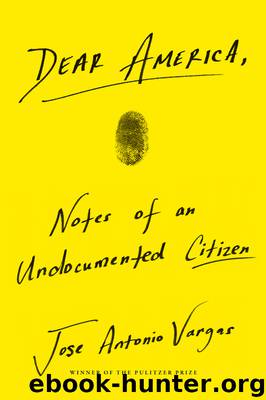
Author:Jose Antonio Vargas
Language: eng
Format: epub
ISBN: 9780062851369
Publisher: HarperCollins
18.
Who Am I?
“Who is Jose Antonio Vargas?” read the headline of a column by Jack Shafer.
Then a media critic for Slate, Shafer proceeded to compare me to Janet Cooke, a Washington Post reporter who won a Pulitzer in 1981 for an article about an eight-year-old heroin addict whom she had made up. “I know the two lies aren’t exactly analogous. Cooke told her lies to inflate her status, Vargas to normalize his,” Shafer wrote. “The trouble with habitual liars, and Vargas confesses to having told lie after lie to protect himself from deportation, is that they tend to get too good at it. Lying becomes reflex. And a confessed liar is not somebody you want working on your newspaper. . . .
“There’s something about this guy,” Shafer concluded, “to make a journalist’s nose itch.”
I understand Shafer’s itchy nose. I cannot stand on a moral high ground, because I lied—repeatedly and knowingly. But his words made me wonder what a journalist is obliged to reveal about his or her life. What privacy do we have a right to regarding our own stories? Had Shafer ever held anything back from his readers, particularly about his personal life? What would have happened if he discovered as a sixteen-year-old that he was an unlawful person in a country that he believed had adopted him as its own? Would he have gone to the nearest airport and flown back to where he had been sent from? What sort of life-altering decisions was he confronted with as a teenager? How did he address them? Journalism is a fishbowl, especially in Washington, D.C. Usually, reporters and editors have less than three degrees of separation. I wanted to email Shafer; he and I had corresponded in the past, after I complimented him on a particular column. I admire his work, and I wanted to talk to him on the phone and explain why I did what I did. But I stopped myself, realizing that I had bigger things to worry about than Jack Shafer’s nose.
Journalism mentors of mine, especially those who were journalists of color, urged me to “toughen up.” Advocacy and journalism are seen as mutually exclusive, especially if you’re a journalist who happens to be a woman, queer, or a person of color, and your mere identity, your very presence, visible or invisible, can be interpreted as political in newsrooms usually run by and populated with straight white men, the framers and enablers of the master narrative. When I first started working in newsrooms in the late 1990s and early and mid-2000s, I was advised not to be so open about being gay. After writing a series of stories about AIDS in Washington, an older editor I admired stopped by my desk one afternoon. “Do you really want to be the gay reporter who writes about AIDS?” said the editor, a white, straight male. “That’s not a way to get ahead here at the Post.” Many journalists, including my own friends, balk at being labeled “advocacy journalists,” as if the designation denigrates their work.
Download
This site does not store any files on its server. We only index and link to content provided by other sites. Please contact the content providers to delete copyright contents if any and email us, we'll remove relevant links or contents immediately.
| Anthropology | Archaeology |
| Philosophy | Politics & Government |
| Social Sciences | Sociology |
| Women's Studies |
Cecilia; Or, Memoirs of an Heiress — Volume 1 by Fanny Burney(32563)
The Great Music City by Andrea Baker(32024)
Cecilia; Or, Memoirs of an Heiress — Volume 2 by Fanny Burney(31962)
Cecilia; Or, Memoirs of an Heiress — Volume 3 by Fanny Burney(31945)
We're Going to Need More Wine by Gabrielle Union(19055)
All the Missing Girls by Megan Miranda(16053)
Pimp by Iceberg Slim(14523)
For the Love of Europe by Rick Steves(14177)
Bombshells: Glamour Girls of a Lifetime by Sullivan Steve(14081)
Norse Mythology by Gaiman Neil(13379)
Talking to Strangers by Malcolm Gladwell(13376)
Fifty Shades Freed by E L James(13247)
Mindhunter: Inside the FBI's Elite Serial Crime Unit by John E. Douglas & Mark Olshaker(9350)
Crazy Rich Asians by Kevin Kwan(9297)
The Lost Art of Listening by Michael P. Nichols(7510)
Enlightenment Now: The Case for Reason, Science, Humanism, and Progress by Steven Pinker(7316)
The Four Agreements by Don Miguel Ruiz(6770)
Bad Blood by John Carreyrou(6626)
Weapons of Math Destruction by Cathy O'Neil(6285)
